Top 5 Injection Machine Robots Transforming Manufacturing Today?
The rise of automation has revolutionized industries across the globe. One of the most significant advancements is the Injection Machine Robot. These robots are reshaping manufacturing processes. They enhance efficiency and precision. Different industries are now adopting them for various applications.
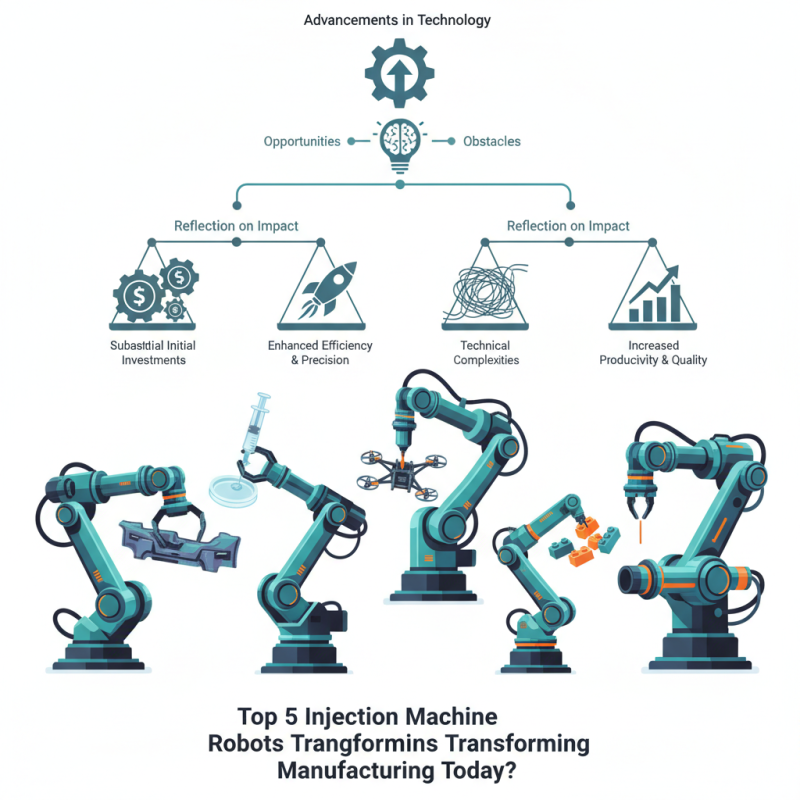
As we delve into the top five Injection Machine Robots, we see both impressive capabilities and potential challenges. For instance, while these robots offer speed, they may require substantial initial investments. Manufacturers must weigh these costs against potential gains. Some factories have reported production issues due to technical complexities.
Nevertheless, the advantages often surpass the drawbacks. With advancements in technology, Injection Machine Robots continue to evolve. They promise a future where precision and productivity are paramount. Embracing this change can lead to both opportunities and obstacles. As we explore these transformative machines, reflection on their impact is crucial.
Emergence of Injection Machine Robots in Modern Manufacturing
The emergence of injection machine robots has significantly altered modern manufacturing landscapes. These robots streamline production processes, enhance efficiency, and minimize errors. According to a recent report by the International Federation of Robotics, the use of industrial robots in manufacturing has surged by 32% over the past five years. This increase is largely due to the adoption of injection machine robots, which are tailored for precision and speed.
Manufacturers are increasingly turning to automation to meet rising consumer demands. In fact, studies show that factories utilizing injection machine robots have reduced production times by up to 50%. However, there are concerns about workforce displacement. The automation trend raises important questions about job security and skill requirements. Not all workers are prepared for this shift, which may lead to a skills gap in the industry.
Despite these challenges, the benefits of injection machine robots can't be overlooked. These robots often operate with remarkable accuracy, reducing material waste. Yet, they require substantial initial investments. Smaller manufacturers may struggle to adopt this technology fully. Balancing costs and advancements remains a complex challenge within the sector.
Key Features of Advanced Injection Machine Robots
Injection molding technology is undergoing a significant transformation. Advanced injection machine robots are leading this change. These machines streamline production and enhance efficiency in manufacturing. A recent industry report indicates that the global market for injection molding robots is expected to grow by more than 10% annually through 2026.
One key feature of these robots is their precision. They ensure accuracy in material placement, reducing waste. This is critical, as studies show that up to 5% of materials are often wasted in traditional methods. Automation also speeds up the manufacturing process. Robots can work continuously without breaks, significantly increasing output.
Tips: Consider adopting robots to minimize labor costs. Evaluate the initial investment against potential long-term savings.
While these advancements are impressive, they come with challenges. Training staff to operate sophisticated robots can be
time-consuming. Additionally, maintenance of these machines requires specialized knowledge. It's important for manufacturers to weigh the benefits against these potential hurdles.
Embracing this technology can lead to greater efficiency, but it may require a shift in operational strategy.
Exploring these advanced robots can enhance competitiveness. Remember,
resistance to change can hinder progress in an evolving industry.
Top 5 Leading Robotics Solutions for Injection Molding
The rise of robotics in injection molding is reshaping manufacturing processes. Advanced robots are now enhancing efficiency, precision, and safety in factories. These robots can perform repetitive tasks with minimal human intervention. They enable higher production rates while reducing waste. The incorporation of smart sensors in these machines allows for real-time monitoring and adjustments.
One notable solution is the use of collaborative robots, or cobots. Cobots work alongside human operators, enhancing productivity while ensuring safety. Their design allows for flexible deployment in various environments. Another important technology is the integration of AI in controlling injection machines. AI helps predict maintenance needs and optimize operational parameters. This can lead to fewer breakdowns, yet it requires constant updates and monitoring.
While these advancements are beneficial, challenges remain. Companies must train their workforce to adapt to new technologies. Not all factories are fully equipped to handle such innovations. Effective implementation can be complex, leading to downtime during transitions. Each manufacturing site is unique, and there is no one-size-fits-all solution. This is an ongoing journey toward achieving an efficient, robotic injection molding future.
Top 5 Injection Machine Robots Transforming Manufacturing Today
| Rank | Robot Model | Payload (kg) | Speed (cycles/min) | Precision (mm) | Use Case |
| 1 | Smart Robot A | 10 | 20 | 0.05 | Plastic Molding |
| 2 | Advanced Robotic Arm | 15 | 18 | 0.03 | Automotive Parts |
| 3 | Precision Picker | 8 | 25 | 0.02 | Electronic Assembly |
| 4 | Flexible Robot B | 12 | 15 | 0.04 | Medical Devices |
| 5 | Nano Robotic System | 7 | 30 | 0.01 | Consumer Goods |
Impact of Injection Robots on Production Efficiency and Quality
Injection robots are revolutionizing manufacturing by enhancing production efficiency and quality. They automate the injection molding process, reducing human error. Accuracy is crucial in producing complex parts. These robots ensure that each piece meets stringent standards. Thus, the end products often have fewer defects.
Tips: Regular maintenance of robots is vital. This helps prevent unexpected downtime. Another tip is to train staff on these systems. Proper understanding can minimize mistakes in operation.
Moreover, the flexibility of injection robots allows for quick changeovers. They can adapt to different production needs with ease. This adaptability is important for companies that need to pivot to new products. Yet, challenges remain. Initial setup and programming can be complicated. Companies must invest time in training and fine-tuning.
Tips: Consider starting with a pilot project. This can reveal potential hurdles without overwhelming the team. Also, involve operators in the decision-making process. Their insights can lead to smoother transitions.
Future Trends in Injection Machine Robotics for Manufacturing Industry
The manufacturing industry is rapidly evolving with the advancement of injection machine robotics. Automation is reshaping how products are created. Robots now handle intricate tasks with precision. They reduce human error, but their integration isn't flawless. Transitioning from traditional methods can be challenging. Workers may feel threatened by job displacement. Adaptation is essential for success.
Future trends in injection machine robotics focus on intelligence and flexibility. Smart robots will analyze data in real time. They will optimize production lines dynamically. This could lead to efficient resource use and reduced waste. However, reliance on technology raises concerns. What happens if the system fails? Human oversight remains crucial to ensure safety and reliability.
Investing in training for existing employees is vital. Bridging the skills gap can enhance workforce adaptability. Additionally, continuous assessment of robotic performance is necessary. There will always be room for human creativity and problem-solving. Injection machine robotics will drive innovation, but a balanced approach is needed. Manufacturers should reflect on their strategies to foster synergy between humans and robots.



 Find Your Solutions ▶